
I’ve written about pretty much every corner of north Cornwall on this site — Port Isaac, Polzeath, Bude, the lot — and somehow never got round to doing Tintagel Castle properly. Partly because everyone else already has, and partly because most of what’s out there reads like a leaflet: dreamy about King Arthur, vague on the stuff that actually decides whether your visit goes well. So here’s the version I wish someone had handed me before my first trip — is Tintagel Castle actually worth it, what it costs in 2026, how bad the steps really are, and where I’d point you instead if your knees or your kids aren’t up for it. Nobody’s paying me to say any of this, so I’ll tell you what to skip as readily as what to see.
Is Tintagel Castle worth it?
Yes — but go for the setting and the legend, not for the castle itself. What’s left standing is fragmentary: low walls, foundations, the outline of a great hall and a chapel, scattered across a headland that drops straight into the Atlantic. If you’re picturing turrets and a preserved keep like Windsor, you’ll be disappointed. If you go for the reason most people actually go — a genuinely dramatic clifftop site, the King Arthur connection, and one of the best short coastal walks in Cornwall thrown in for free — it delivers completely.

It’s worth it if you like wild scenery, don’t mind steps, and can treat the ruins as a bonus rather than the main event. It’s not worth it if you’re short on time and just want “a castle” — Cornwall doesn’t really have the fairy-tale kind, and Tintagel’s magic is 90% location. Budget a proper half-day around it rather than a quick stop, and you won’t feel short-changed.
Tickets and booking
Prices below are what I found researching this in August 2026 — English Heritage nudges them up most years and prices now vary by date, so treat these as a guide and check their prices and opening times page before you go rather than relying on any blog, including this one.
| Ticket | Booked online, in advance | On the day, at the gate |
|---|---|---|
| Adult | roughly £15 | roughly £18 |
| Child (5–17) | roughly £10 | roughly £11 |
| Family (2 adults + up to 3 children) | roughly £45–£48 | higher |
| English Heritage members | Free — bring your membership card. Parking still costs extra. | |
The pattern that matters more than the exact numbers: booking online in advance is meaningfully cheaper than turning up and paying at the gate, and English Heritage has moved to a timed-entry system for crossing the footbridge onto the island, mainly to stop the pinch-point bottlenecking in peak season. Book a slot for the time you actually want to arrive, especially in July and August or over half-term weeks — once you’re through, your ticket is valid all day and there’s no rush to leave. Under-5s go free, and Cornwall Heritage Trust membership is worth a look if you’re doing several Cornish heritage sites in one trip.
Getting there and parking, honestly
There’s no train station in Tintagel — nearest options are Bodmin Parkway or further out via Exeter, both meaning a bus or taxi for the last leg — so almost everyone drives, mostly via the A39. Sat nav for Tintagel village itself, not “Tintagel Castle,” since the castle entrance is a walk from the village rather than a car park you drive straight up to.
Parking is pay-and-display in the village, not at the site — the main car parks sit on Atlantic Road and Fore Street, roughly 600 metres from the castle entrance. Budget 15–20 minutes to park and walk down, longer once you add the queue for a space in August. Expect a few pounds an hour, more like a fiver-plus for a full day depending on which car park you land in — nothing that’ll ruin your trip, but don’t expect to nip in for twenty minutes and pay 60p either. There’s a limited Land Rover shuttle from the village toward the site, but it only covers part of the route (roughly café to the halfway point) — it’s not a door-to-door service, and it won’t save you much walking either way. Go early if you can; the village genuinely fills up by late morning most of the summer.
The steps, the bridge, and who’ll struggle
This is the section most guides skip, and it’s the one that actually changes people’s day. The famous footbridge — opened in 2019, still very much open and one of the best bits of modern design in Cornwall — spans the gorge between the mainland and the island in two cantilevered halves that don’t quite touch in the middle, a deliberate 40mm gap standing in for the jump between history and legend. It’s dramatic, it’s completely safe, and if heights genuinely aren’t your thing, know that it’s high, exposed, and see-through in places before you commit.
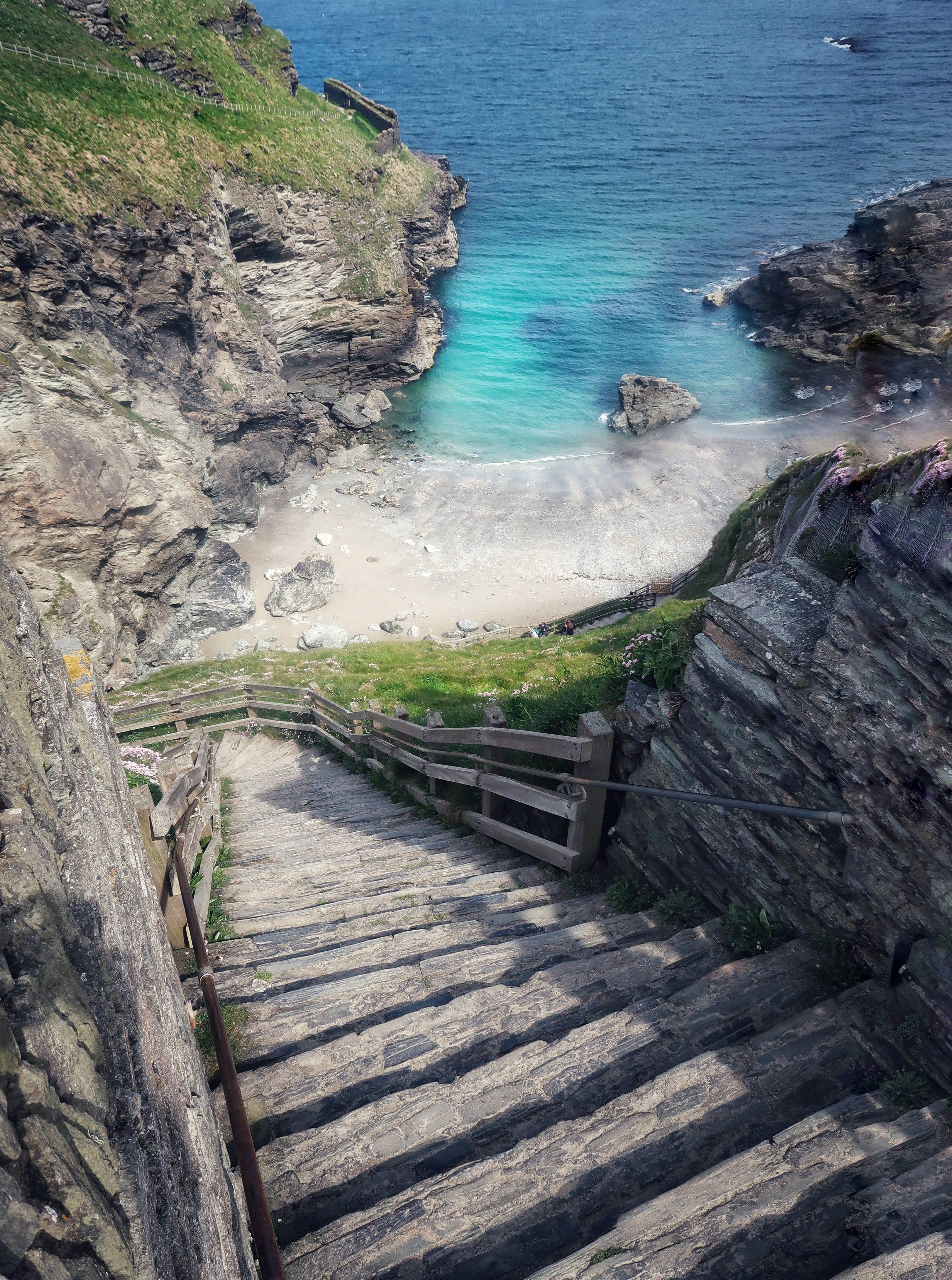
The bridge itself is step-free. The problem is everything after it. The main route around the island is one-way and involves around 140 steep steps if you do the full loop, mostly on the way back off the headland — there’s no way to see the higher ruins and the classic viewpoints without them. You can dodge the steps entirely by turning around and recrossing the bridge instead of continuing the loop, which gives you a genuinely step-free way to see a decent amount of the site. English Heritage has also added a step-free path and a limited shuttle drop, but be realistic about it: the shuttle only runs part of the way, and the last stretch — roughly the final 100 metres up to the ruins — is still a steep, unassisted walk.
Practically: if you or anyone in your group uses a wheelchair, has limited mobility, or is pushing a buggy, ring ahead on 01840 770328 before you book — the team will talk you through exactly what’s realistic on the day rather than you guessing from a website. If it’s just tired legs or nervous knees, know your limits going in and use the bridge-and-back option rather than forcing the full loop. Slate gets properly slippery when it’s wet, which in Cornwall is often, so factor that into footwear regardless of fitness.
What to actually see
Once you’re across the bridge, three things are worth building your visit around. Gallos — the eight-foot bronze figure by sculptor Rubin Eynon, installed by helicopter and unveiled in 2016 — is the one everyone photographs, and English Heritage is careful to say it isn’t meant to be a literal King Arthur, more a ghostly stand-in for the site’s long line of kings. It’s genuinely striking in person, with gaps cut through the bronze so the landscape shows through it, and it’s worth timing your visit for a quieter moment if you want the photo without twenty other people in it.
Merlin’s Cave is the other big draw, and the one people most often get wrong. It’s a sea cave that runs right through the headland, accessible from the beach below — and it only fully opens up at low tide. At high tide the tunnel floods end to end and is genuinely dangerous to be caught in; don’t try to beat the incoming water. Check tide times for the day of your visit before you go (any UK tide site will do), and build your castle visit around low tide if the cave matters to you. Handy bonus: you can see the cave and the beach without a castle ticket at all, since it’s accessed from below rather than through the paid entrance — more on that in the FAQ.
Beyond those two, the island interior is atmosphere over architecture — the outline of the medieval great hall, the remains of a chapel, terraced gardens, and clifftop views in every direction that are the actual reason this place has drawn writers and romantics for centuries. Go in expecting a wild headland with history scattered across it, not a preserved castle, and it lands completely differently.
Make a day of it
Tintagel village itself is worth twenty minutes rather than a full stop — it leans heavily into the Arthurian theme (expect a lot of “Excalibur” branding), but the Old Post Office is a genuine highlight: a wonky 14th-century National Trust house that looks like it’s been slowly melting for six hundred years, open through the main season and closed over winter, so check before you plan around it.
For the coast, Bossiney Cove is about a mile east along the coast path — a proper sandy beach that’s only fully exposed at low tide, quieter than the castle beach, and dog-friendly year-round. Tintagel itself is surprisingly dog-friendly too: the castle welcomes dogs on leads (mind the steps and the sheer edges), with water at the café — more canine-approved sand in our dog friendly beaches in Cornwall guide. If you want a bigger day out, Boscastle is a short drive away or a genuinely excellent coast path walk if you’re up for several hours of proper Cornish clifftop hiking — one of the best short stretches of the South West Coast Path anywhere in the county, taking in Rocky Valley and Benoath Cove on the way.
Tintagel sits right in the middle of the north coast, so it slots naturally into a wider trip. For the fishing-village version of this coastline, see the Port Isaac guide; for the family beach version, see Polzeath; for the full regional picture including Bude and Padstow, see the North Cornwall guide. And if you’re still working out where to base yourself for the trip, the where to stay in Cornwall guide matches areas to trip types honestly, downsides included.
FAQ
How long do you need at Tintagel Castle?
Budget a minimum of two hours once you’re through the gate, and closer to half a day once you count parking, the walk down, and a stop at the Old Post Office or a café in the village. Add more if you’re doing the coast path out to Bossiney Cove or beyond, or if you’re waiting around for low tide to see Merlin’s Cave properly.
Is Tintagel Castle free for English Heritage members?
Yes. English Heritage members get free entry — just bring your membership card, and you can still book a timed slot online if you’d like one. The one thing membership doesn’t cover is parking in the village, which you’ll pay for regardless.
Can you visit Tintagel without paying?
Partly. You can walk the South West Coast Path above the site and get genuinely dramatic views of the castle for free, and you can reach Tintagel Beach and Merlin’s Cave from below without a ticket, since that approach doesn’t go through the paid entrance. What you can’t do without paying is cross the footbridge onto the island itself or get up among the ruins — that’s the bit that needs a ticket.

Meet Ben, a wanderlust-stricken wordsmith hailing from the surf paradise of Newquay. With a pen and a passion for storytelling in hand, from rugged coastal hikes to secret spots off the beaten tourist path, join Ben as he guides you through the very best of what Cornwall has to offer.