
Ask anyone who’s never been what the Eden Project actually is and you’ll get some version of “big greenhouses, right?” Ask anyone who has and you’ll usually get something closer to reverent. Both answers are true, and that gap is exactly why it’s Cornwall’s most argued-over attraction — genuinely brilliant to some visitors, genuinely overpriced to others, rarely much in between. I’ve been in blazing August heat and in grim February drizzle, and I think both camps have a point. So here’s the honest version: whether it’s worth the money in 2026, the trick that turns one ticket into a year of free return visits, what’s actually inside those domes, and who’s going to struggle with the heat, the slope, or the price tag.
Is the Eden Project worth it?
Yes — but go in knowing exactly what you’re paying for: two enormous covered Biomes, a big outdoor garden built into an old clay pit, and one of the best wet-weather days out anywhere in the county. It is not a theme park, and it’s not a “garden” in the National Trust sense either. The case against it writes itself: the tickets aren’t cheap, and reduced to its bones it is two very large greenhouses. Fair. But there’s nothing else in the UK quite like walking into a humid, roaring rainforest under a Cornish sky ten minutes earlier, and the outdoor site — sculptures, planting, the Core building — is genuinely more than most people expect from the photos.
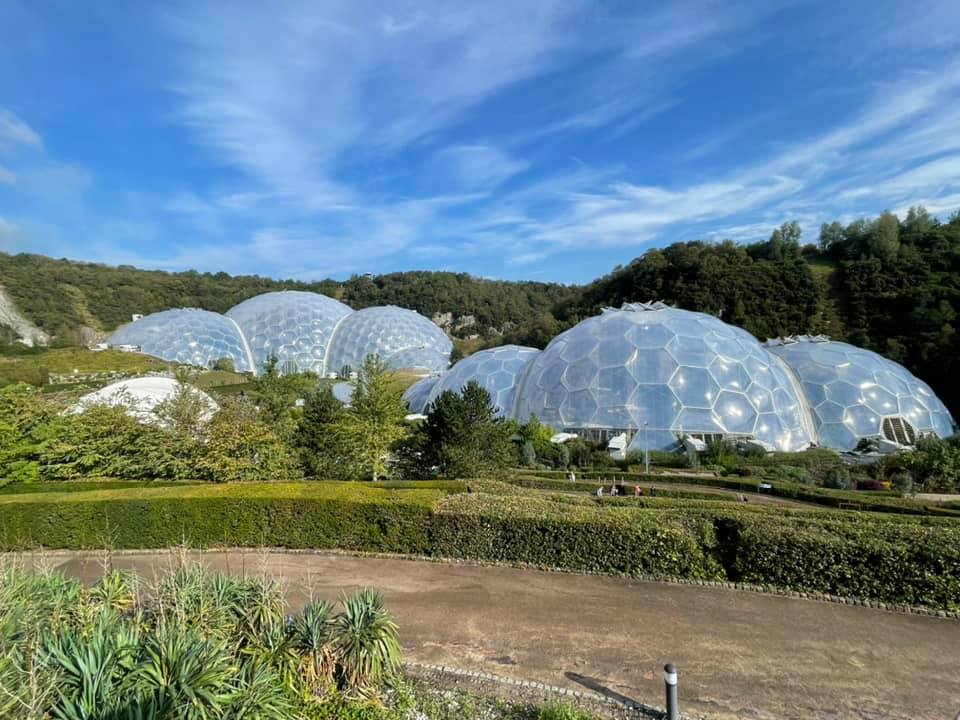
Where it earns its reputation is on a bad-weather day. Cornwall gets a lot of rain, and most of Eden’s big draws — the Biomes, the Core, most of the food options — are under cover. If you’re stacking a week here and the forecast turns, this is the one that doesn’t get cancelled. For more on making peace with a soggy Cornish forecast generally, see our guide to Cornwall in the rain.
Where it doesn’t earn its reputation is if you’re expecting a full day of constant activity for the money, or if you’ve already done it once and are weighing up a repeat full-price visit without knowing about the annual pass trick below (read that bit before you decide). Budget half a day minimum, go in with realistic expectations about the size of the outdoor gardens versus the two headline Biomes, and it’s a genuinely good use of a Cornwall day — just not a cheap one.
Tickets, and the annual pass trick
Prices below are what I found researching this in August 2026 — treat them as a guide, not gospel, and check Eden’s own admission prices page before you book. Two things make Eden’s pricing more fiddly than most attractions right now, so it’s worth reading both before you panic at the headline number.
First: Eden is currently part of the government’s temporary “Great British Summer Savings” scheme, a VAT cut on visitor attractions running from 25 June to 1 September 2026, which knocks a meaningful chunk off the price if you’re visiting this summer. Roughly speaking, advance adult tickets currently sit in the low £30s, with on-the-day tickets a few pounds more. Child tickets (5–15) are currently in the low-to-mid teens, and under-5s are free (up to four per accompanying adult). Once that scheme ends on 1 September, prices are set to step back up — likely to somewhere in the mid-to-high £30s for an advance adult ticket, based on Eden’s own “standard” pricing. If you’re reading this after September 2026, expect the higher figures and check the official page for the exact current number rather than trusting any blog, including this one.
Second, and this is the fact that actually saves people money: a standard general ticket to Eden is also, automatically, a year-long pass for free return visits. Eden treats the ticket price as a charitable donation rather than a one-off entry fee, and in exchange your ticket converts into an Annual Pass valid for twelve months — you just need to pre-book your (free) return slot online each time before you go. There’s no separate membership fee for this baseline version; it’s built into the standard admission price. If you already know you’ll want to go back — with different family members, in a different season, for the Eden Sessions gigs — this is genuinely the single most useful thing to know before you buy, and it’s the reason a “one visit” ticket often ends up being three or four over the year. (Eden also sells a separate paid Family Membership, currently priced around £112.50 with Direct Debit, aimed at people who want the extra perks that come with formal membership rather than just the free-return conversion — worth comparing against your household’s likely visit frequency before choosing.)
There’s no single “family ticket” as such — you book individual adult and child tickets and the running total works out family-priced in practice, especially with under-5s free. Booking in advance online is noticeably cheaper than turning up and paying on the day, and given Eden does get busy, it’s worth doing regardless of the saving.
Getting there and parking
Eden sits just outside St Austell, a few minutes off the A30/A391, and it’s well signposted from pretty much every direction once you’re in mid-Cornwall. Parking is free, with electric vehicle charging points available on site — a genuinely welcome bit of honesty in an industry that usually charges for the privilege of parking near the thing you’re already paying to enter.
The one thing worth knowing before you arrive: Eden is built inside a former china clay pit, so the car parks sit above the site itself. It’s roughly a ten-minute walk downhill from the car park to the entrance — pleasant enough on the way in, less pleasant as a twenty-minute uphill trudge back to the car at the end of a long day. A free shuttle bus runs from the car parks during peak times if you’d rather skip the walk either way, so don’t assume you’re stuck with the hike if mobility or small legs are a factor.
By train, the nearest useful station is St Austell, on the main London Paddington line, from where buses 26, 28 and 31 run to Eden in around 25 minutes (check current timetables — bus 31 doesn’t run on Sundays, and frequencies vary through the day). Par station is also in the area but St Austell has the more direct bus connections, so it’s the better bet for a car-free visit.
For timing, weekdays and either the first or last couple of hours of opening tend to be noticeably quieter than a summer Saturday lunchtime — coach parties and school-holiday families cluster in the middle of the day. If you can visit outside the summer school holidays, September is a genuinely good shout: warm enough for the outdoor gardens, cooler in the Biomes, and quieter throughout — see our guide to Cornwall in September for the wider case.
What’s actually inside
The two Biomes are the headline act, and they’re genuinely different experiences rather than just “big” and “bigger.” The Rainforest Biome is the one people talk about — a humid, densely planted world that’s kept properly warm year-round, with a canopy walkway that climbs up through the tree line for a view down over the whole thing. It’s the most physically demanding part of the visit simply because of the heat and humidity (more on that below), but it’s also the closest thing to travelling somewhere else entirely without leaving Cornwall. The Mediterranean Biome is smaller and gentler — olive groves, vines, citrus, the kind of warm, dry planting you’d expect from southern Europe or California, and a good place to cool off (relatively) after the Rainforest.
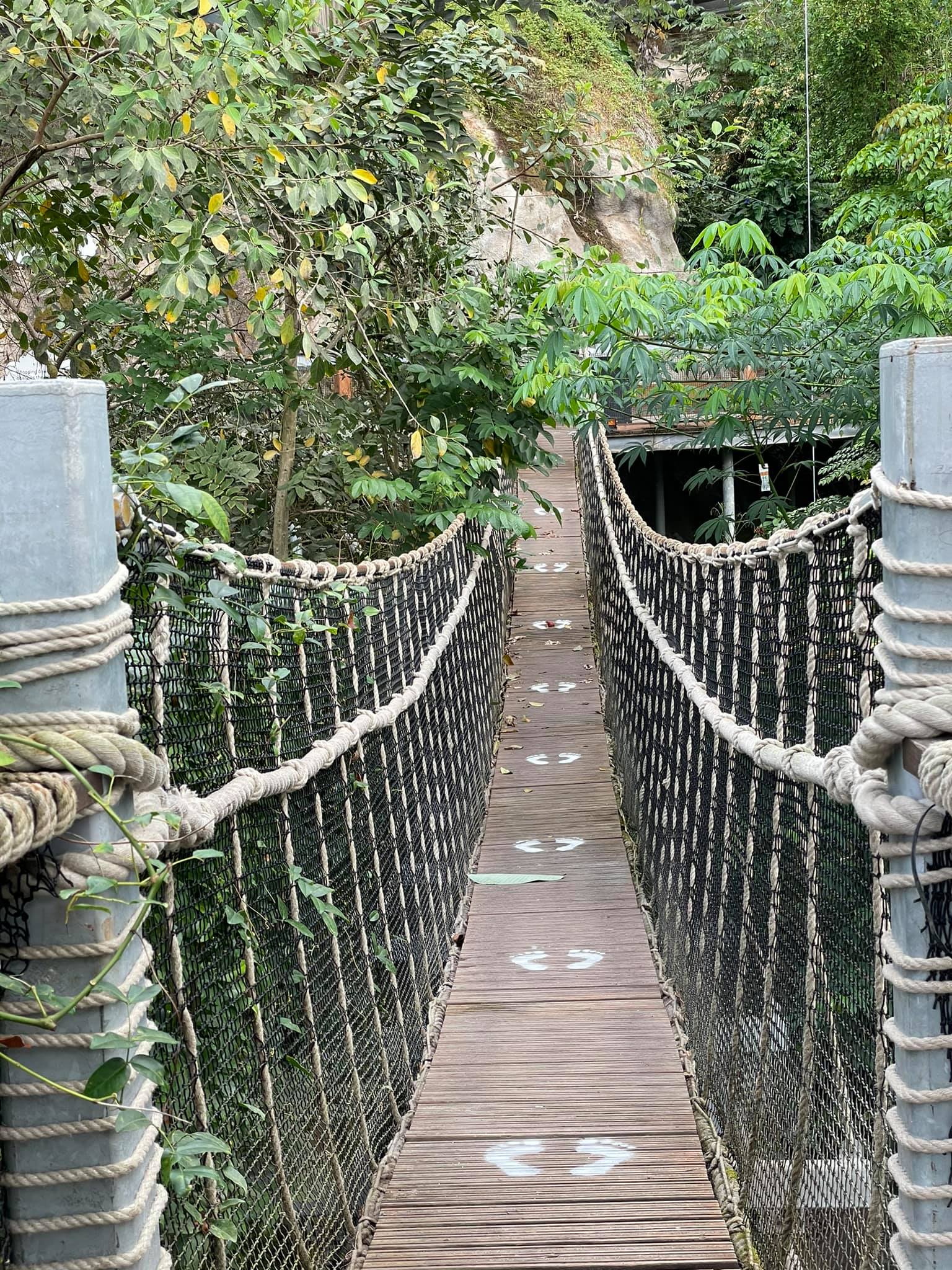
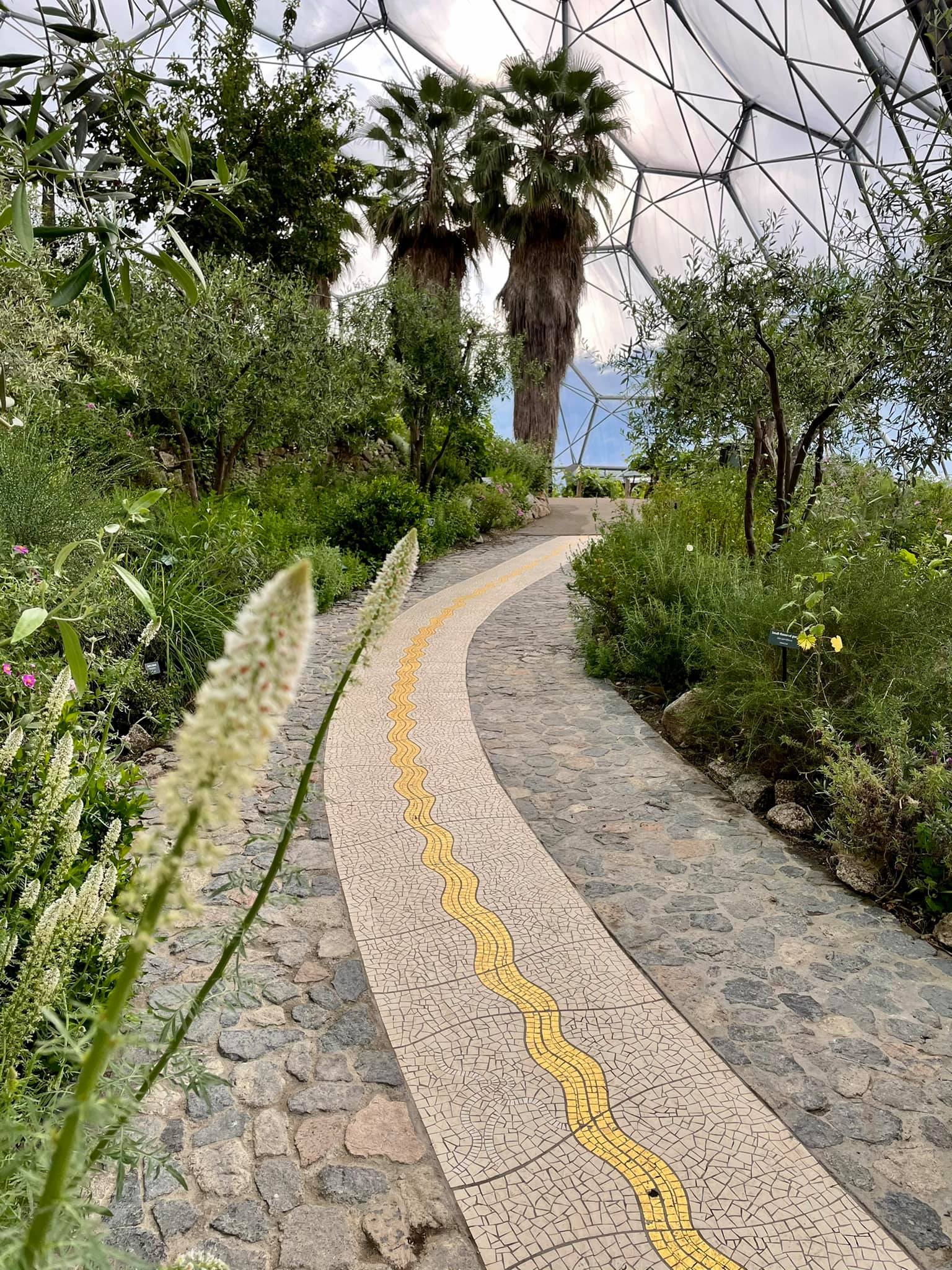
Outside the Biomes, the outdoor gardens cover a genuinely large part of the site and are easy to underestimate from the photos — sculpture, seasonal planting, and a programme that changes through the year. If gardens generally are your thing beyond Eden, our guide to gardens in Cornwall rounds up the rest of the county’s best. The Core building rounds out the covered attractions — part education space, part events venue, part somewhere to shelter with a coffee if the rain’s coming down outside the Biomes too.
The zip wire and Hangloose
Eden’s other headline draw isn’t actually run by Eden. Hangloose Adventure operates a separately ticketed adventure park on site, built around SkyWire — a 660-metre zip wire that Eden’s own site bills as England’s fastest, reaching speeds of up to 60mph as you fly head-first over the Biomes. Some marketing also calls it England’s longest; the claims vary slightly by source, so treat “fastest and longest” as the marketing version and “genuinely fast, genuinely long” as the safe one. Hangloose also runs Gravity, a giant swing that drops from height, and SkyTrek, an aerial trekking course.
The important bit: Hangloose tickets are not included in Eden admission, and you don’t need an Eden ticket to do Hangloose activities on their own, since the adventure park sits outside Eden’s pay perimeter. Rough current pricing has the zip wire alone starting from around £15, with combined Eden-admission-plus-zip-wire packages starting from around £50 and working out cheaper than buying both separately — but check Hangloose’s own site for exact current prices and availability before you commit, since adventure-activity pricing moves around with the season.
Worth a mention if you’re planning a summer trip: Eden’s outdoor Amphitheatre also hosts the annual Eden Sessions gigs, a run of big-name outdoor concerts each summer. The 2026 run had already wrapped by the time this was written in August, so if you’re reading this later in the year, check edensessions.com for next year’s lineup and dates rather than assuming this year’s.
Who’ll struggle
Be honest with yourself about three things before you go. First, the Rainforest Biome heat — it’s kept genuinely warm and humid year-round, and it can get properly hot in the upper canopy on a busy summer day. Anyone with a heart condition, breathing difficulties, or a general dislike of humidity should pace themselves, and there’s a cooler rest area partway up the canopy walkway if it gets too much. Small children and anyone prone to overheating will likely want a shorter visit to that Biome than the adults in the group.
Second, the pit itself. Eden is built inside a former china clay quarry, and the whole site is on a slope — zig-zag paths keep the worst of the gradients manageable, but it’s not flat, and there’s a lot of ground to cover if you’re doing the full site. The free shuttle bus and the Land Train (which runs from the Visitor Centre down to the base of the pit and can carry wheelchairs) both help, and there are lifts between the highest and lowest points on site, so it’s genuinely more manageable than the raw gradient suggests — but don’t plan on it being a flat, easy stroll.
Third, accessibility more broadly — Eden takes it seriously, with an all-terrain mobility scooter available to hire through a partnership scheme for tackling the steeper sections, plus the Land Train and lifts above. If mobility is a genuine concern for anyone in your group, it’s worth reading Eden’s own accessibility guide before you book rather than finding out on the day.
Dogs are welcome in the outdoor gardens at no extra charge, but not inside the Biomes, the Link Building walkway between them, or the children’s play areas — guide dogs are exempt throughout. And if you’re travelling with young children, factor the heat and the walking distances into your day rather than assuming it’s an easy toddler outing — our Cornwall for kids guide has more on which attractions genuinely suit which ages.
Make a day of it
Eden sits close enough to a handful of good stops that it’s easy to build a full day around it rather than just the visit itself. St Austell itself is a few minutes away and worth a look beyond being “the town near Eden.” Charlestown, the small Georgian harbour a short drive south, is one of the most photogenic spots in the area and a good place for lunch by the water. Heligan (the Lost Gardens) makes a natural pairing if you want a second, very different garden experience the same trip — softer, older, more overgrown-on-purpose than Eden’s engineered Biomes. And Fowey, a proper working harbour town with genuine character, is close enough for an evening finish if you’ve got the whole day free.
If you’re stacking this trip with Cornwall’s other big single-attraction days out, this is the third in a short series — see our honest guides to Tintagel Castle and St Michael’s Mount for the same treatment applied to Cornwall’s other two most-searched icons. And if you’re still deciding where to base yourself for the wider trip, our where to stay in Cornwall guide matches areas to trip types honestly, downsides included — mid-Cornwall around St Austell puts you within easy reach of Eden, Heligan and the south coast harbours in one go.
FAQ
How long do you need at the Eden Project?
Plan on at least half a day — realistically four to five hours if you want to properly cover both Biomes, the outdoor gardens, and a food stop, without rushing. Add more if you’re doing Hangloose’s zip wire or adventure activities on top, since those are booked as separate timed slots.
Is the Eden Project worth the money?
For most visitors, yes — but go in knowing what you’re paying for. It’s genuinely expensive compared to a lot of Cornwall’s outdoor attractions, and at its core it is two large covered Biomes plus outdoor gardens, not a theme park’s worth of activity. Where it earns the price is the experience inside the Rainforest Biome, which has no real equivalent elsewhere in the UK, and the fact that a standard ticket also converts into a free-return Annual Pass for the following year — which meaningfully changes the value equation if you’re likely to visit more than once.
Can you revisit the Eden Project for free?
Yes, within certain limits. A standard general admission ticket automatically converts into an Annual Pass, giving you unlimited return visits for twelve months from your first visit — you just need to pre-book a free timed entry slot online each time you want to return, subject to capacity. It’s worth checking Eden’s current terms before you rely on this, since the exact conditions can be adjusted, but as of 2026 this remains genuinely one of the best value mechanics of any UK attraction.

Meet Ben, a wanderlust-stricken wordsmith hailing from the surf paradise of Newquay. With a pen and a passion for storytelling in hand, from rugged coastal hikes to secret spots off the beaten tourist path, join Ben as he guides you through the very best of what Cornwall has to offer.